BPC-157 and TB-500 are the two most reordered repair-pathway research peptides in our Australian catalogue. Here is how labs actually use, store and document them.
Outside the incretin category, no two compounds move faster off the Purity Labs shelf than BPC-157 and TB-500. They are frequently discussed together, which obscures the fact that they are structurally unrelated and behave quite differently in the freezer, in solution and on the chromatogram.
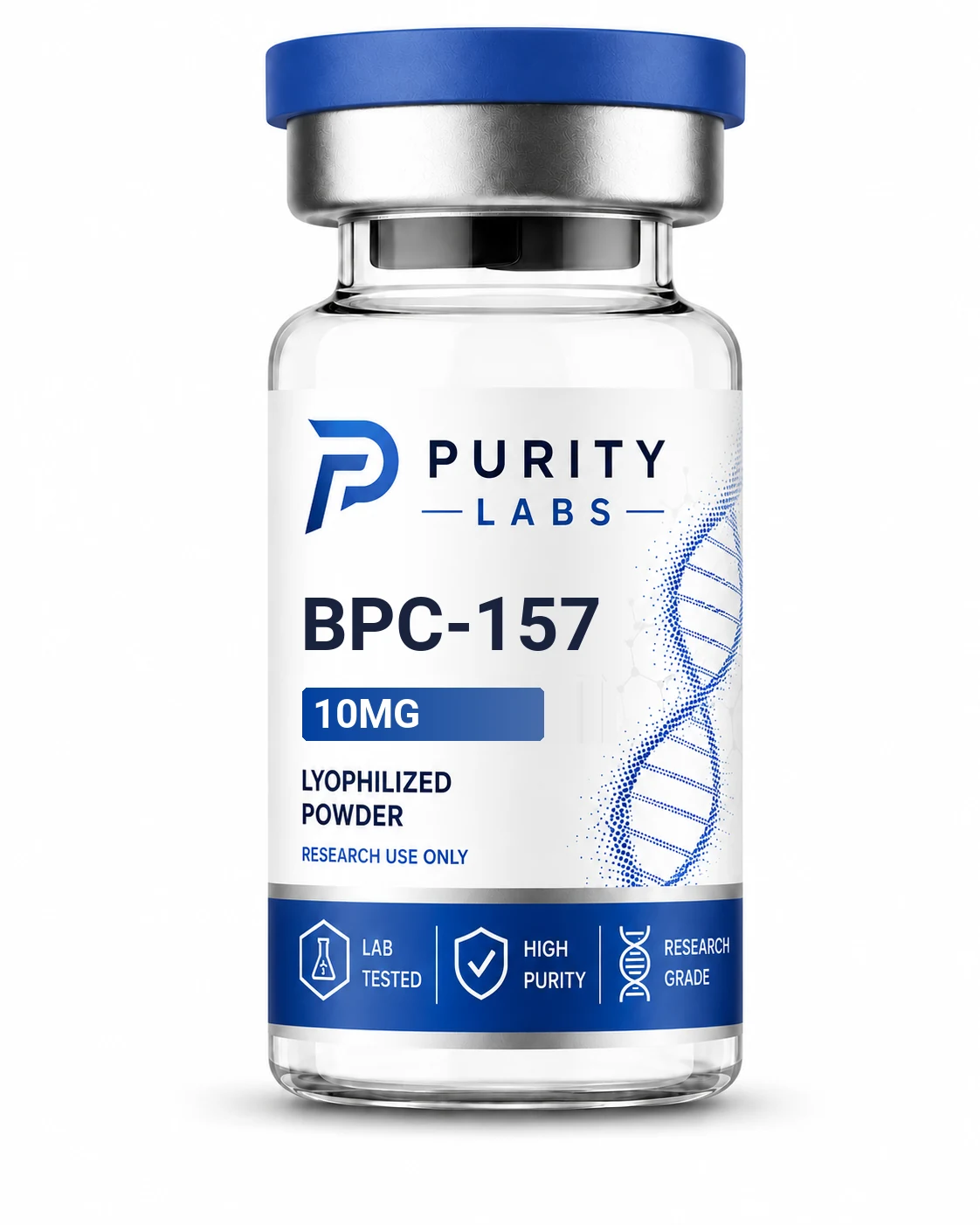
BPC-157 in brief
A synthetic fifteen-amino-acid sequence derived from a fragment of a protein found in gastric juice. It is unusually robust for a peptide of its size, which is one reason it appears so often in in-vitro angiogenesis and fibroblast migration models where a fragile compound would be impractical.
TB-500 in brief
A synthetic fragment corresponding to the active region of thymosin beta-4, most often studied for actin-binding behaviour and cell migration endpoints. It is typically supplied at 5 mg or 10 mg and dissolves readily.
Where they are used together
- Comparative wound-model in-vitro assays where migration and proliferation endpoints are read separately.
- Blended reference material studies — Purity Labs also stocks a pre-blended BPC-157 / TB-500 presentation for labs standardising on a fixed ratio.
- Stability benchmarking, since the two compounds degrade on visibly different timelines in the same buffer.
Reconstitution reference
| Vial | Bacteriostatic water | Resulting concentration |
|---|---|---|
| 5 mg BPC-157 | 2.0 mL | 2.5 mg/mL |
| 10 mg BPC-157 | 2.0 mL | 5 mg/mL |
| 5 mg TB-500 | 1.0 mL | 5 mg/mL |
| 10 mg TB-500 | 2.0 mL | 5 mg/mL |
The Purity Labs reconstitution calculator will run these numbers for any vial size and target concentration, and prints a summary you can attach to a lab notebook entry.
Storage in an Australian climate
Lyophilised material at −20 °C, protected from light, is stable well beyond twenty-four months. Reconstituted material belongs at 2–8 °C, away from the fridge door where thermal cycling is worst, and ideally aliquoted for single use. In Queensland and the Northern Territory we recommend receiving parcels to an address that is attended during the day rather than leaving them in a letterbox through the afternoon.
Does Purity Labs sell a pre-blended option?
Yes — a combined BPC-157 / TB-500 presentation is stocked alongside the individual vials for labs that have standardised on a fixed ratio.
What purity do these release at?
The same 99%+ HPLC-MS release floor applied to every compound in the catalogue, with the certificate published against the lot reference on the vial.
How fast do they ship within Australia?
Same business day on cleared payment before 2pm AEST, via Auspost Express with tracking, free on orders over $100.